
A Dark Song
The Fandom of Christendom Series #16

I’ve been overcome by events in my career—I suppose from the outside looking in, these events would be what most people would consider “good” and “successful,” but primarily they were “time consuming.” These events provided the excuse for me to fall off the bandwagon and not post for a few months, and the most I’ve done is jot down notes to myself for the “Fandom of Christendom” series. I always had a vague outline of what I wanted to say, but what is going on in my head versus what makes it onto paper are generally two different things. We are more than likely approaching the end of the series, and it’s probably better that I had some time to reflect on exactly what will go into this final foray.
To start, let’s address the title of this essay. “A Dark Song” is actually a movie from 2016. I’m not exactly sure when it appeared on my radar, but it was before COVID ever hit, and I didn’t see it in theaters so I’m guessing it must have been between 2017-2019 when I watched the entire movie on my own.
Disclaimer: This is NOT a movie for children, and it covers a lot of (obviously) dark material. You can read the parent’s guide here:
https://www.imdb.com/title/tt4805316/parentalguide/
It hooked me from the opening scene, which is nothing more than a black screen with white text, stating:
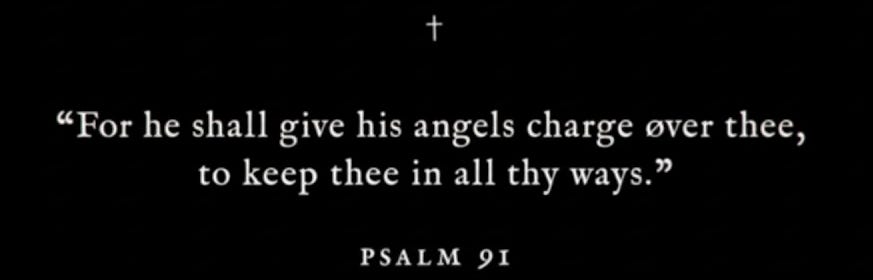
The movie follows a grieving mother, Sophia Howard, approximately three years after her son died in vague and ambiguous circumstances for which she blames herself. Beyond that, the audience is not privy to any further details. She hires the abrasive and cynical occultist Joseph Solomon to perform a grueling, months-long ritual known as the Abramelin Operation in a secluded house in Wales. The complex, lengthy, and demanding ceremony is detailed in a 15th-century grimoire of the same name and is essentially meant to call on one’s guardian angel who will grant them a request.
Her initial stated goal is to speak with the soul of her young son, but as the story—and the ritual—progresses, it begins to peel back the layers of her suffering, her unwillingness to compromise, and the more sinister, hidden motives behind her relentless quest.
The first hint of these hidden motives is an encounter Sophia has with her younger sister in a grocery parking lot. Her sister is aware of her intentions in starting the ritual and tries to sway her off the path.
“This stuff is black,” her sister pleads.
“So you believe it now?” Sophia retorts.
“I believe in God.”
“What’s that supposed to mean?” Sophia hisses at her.
“Is this something godly?”
The implied answer, of course, appears to be “No,” but Sophia brushes the concerns aside and tells her sister: “I am going to do this. It doesn’t matter if it’s right or wrong.”
This is probably a succinct summary of my mental state during this time period. The further I advanced down the elevator, the more obvious it became that the rightness or wrongness of what I was doing was no longer a factor.
I’m sure the atheist, seeing how I was spinning myself into a frenzy, would probably offer Richard Dawkins’ bus ad campaign quote as consolation.
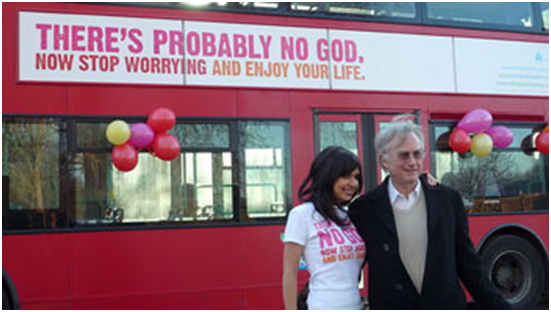
Wow, thanks! That fixed everything.
While the Christian might offer equally unhelpful advice along the lines of, “You can’t put God in a box. You have to have faith. He’ll answer in his own time.”
Neither of these options was satisfactory to me. At the beginning of this series, I said I wanted certainty instead of faith. While I gave you a peek into my thinking at the beginning, now is the time to dispel all ambiguity: When I say I wanted certainty, I mean I wanted certainty.
No, “Maybes.” No, “Take it on faith.” No, “Trust in God.” No, “It’s a mystery.”
I would have certainty, even if the only person being convinced was myself. Since God (if there even was one) seemed to have hidden behind the clouds He’s so famously depicted in, and I was already well on my way down the elevator, I decided I would use the nightmare fuel I’d encountered on my journey to propel myself toward the other half of this celestial “equation.”
It was time to answer the follow-on question. We can all agree as humans that the world holds a certain level of unpleasantness, but what I truly wanted to know was this: was there anything behind the seemingly senseless, overwhelming, and unrestricted malevolence that existed so casually among the mundanity of life?
Now, the Christians (and some other religions) have their own names for this personified evil, the most popular being Satan, Lucifer, Old Scratch, and the devil. I’ll even throw in a few more titles that I picked up during my experiences: the terror of the Stars, the Machine, and the Managerial. Oddly enough, those last two arrived after the completion of my journey, but I could instantly recognize them as suitable titles for this “thing” I wanted to encounter.
This wasn’t a quest to find some caricature of evil, like the commonly depicted red demon with a pitchfork—if there was something waiting at the bottom of the abyss, and if the evil I’d studied was any indicator, the encounter would probably be far worse. Neither was I about to pull out an Ouija board, start a séance, or draw pentagrams on the ground. The ceremony I devised would be of my own making—and writing seemed the best medium since I already had a passing familiarity with it.
I’d been writing “The Fault in the Stars” off and on for two years at this point (yes, the same book posted for free on my Substack) without any clear idea where it was leading. But now I had an end state in mind, and it seemed the perfect vehicle to confront this personified evil, if there even was such a thing. There were dreams, flashes of insight, and lengthy, unwieldy thoughts that slowly assembled the book and framework I would use for this experience.
I couldn’t help but notice that from both the atheistic side of the aisle and the religious side, there was a fixation on scoring points and being “right” rather than getting to the heart of the matter. I wasn’t interested in scoring points—I was interested in the t(T)ruth, however uncomfortable and unrecognizable its final form might look like. If that ultimately led me away from my religion, so be it—I would find a way to assemble a new world view without it.
On the other hand, if the Catholic Church held any sort of mystical power, if the sacraments and graces they talked about actually meant something more than the meaning its adherents assigned them, then perhaps I could use my own (in)version of them to get me to the heart of darkness. And if I truly got in over my head, maybe, just maybe, they would activate in my defense in the moment that I needed them most.
I suppose the words of the Gospel of Matthew would come to mind here, where the Tempter tries to convince Jesus to throw himself off the top of the temple since God’s angels will protect him. Jesus answers him, saying, “It is also written: ‘Do not put the Lord your God to the test.’”
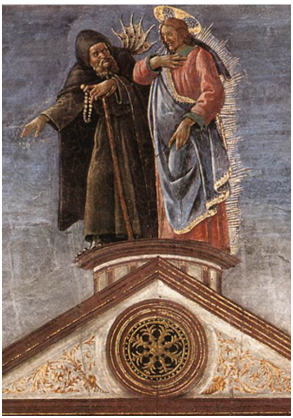
“See? It’s not even that far down.”
I’m sure my “elevator” had already plunged right by the temple, managed to miss the ground, and headed straight into the abyss, since I was nearly fully convinced there wasn’t even a god to test.
Perhaps this was the saving grace of my descent: deciding at this juncture that the only thing being sacrificed was myself—my beliefs, my ingrained morals, my time, my sacred cows, my assumed perspectives on life. The unending and unquestioned accumulation of experiences that made me, me—those were what was on the altar. They must be analyzed, dissected, and, if required, destroyed as they butted up against this “evil.” If there was a price to pay, I’d pay it.
While life circumstances certainly did not lend themselves to committing to “the ritual” in the way that Sophia and Solomon did in the movie, many of the themes remained the same. In all outward appearances, my life continued on as usual. The foreground operations—the career, the relationships, the bills—those went on. The background is what was consumed by this seemingly improbable and impossible task.
Here is where we are going to hit the cumbersome part of the essay. I’m going to recount some of my experiences from this multi-year journey in no particular order. I’m not out to “prove” anything in particular—I’m simply recounting what I sensed at the time it was happening. Those of my readers who are of the Christian persuasion and have at least a passing understanding of Church doctrine and theology might be apprehensive of some of the items I recount, since they certainly don’t lend themselves to orthodox thinking, while those of the not-Christian persuasion are probably just going to wonder, “What is this guy going on about?”
The first subject I want to talk about is the object of the quest itself—that evil personified I spoke of earlier. For convenience’s sake, we’ll just say it was the Devil. We have many popular cultural references to the devil: “The devil made me do it.” “The devil got into them.” Even the St. Michael the Archangel prayer, where we have Satan, and all the evil spirits, who prowl about the world seeking the ruin of souls. Sounds like an extremely busy guy. Perhaps the first point I would make is that Christians seem too hasty in attributing just about anything that goes wrong to the machinations of the Devil, while the anti-theists rely solely on the material components for all the mayhem that goes on around here.
The experience didn’t find a busy-body demon, running around the world convincing people to do this or that in endless, mischievous attempts to get people to mess up their lives. In many ways, I suppose it could be described as a journey to the source of something—the sickness and toxicity grew almost imperceptibly with each step until it infected every thought and action. Fortunately, if that didn’t explain it well enough, I have a picture to show exactly what I mean:
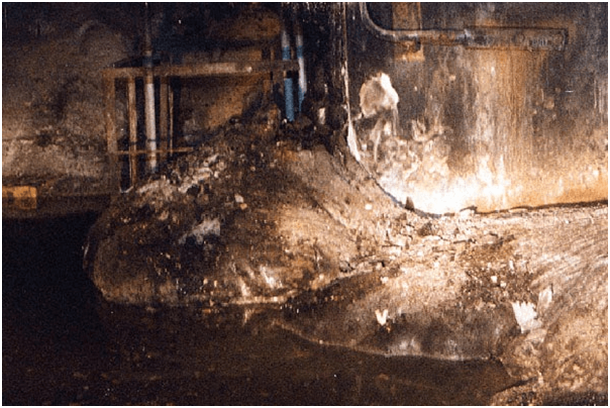
The Elephant’s Foot from the 1986 Chernobyl Nuclear disaster
That is the Elephant’s Foot: a deadly radioactive mass of corium—a composition of molten nuclear fuel, concrete, sand, and other materials formed during the 1986 Chernobyl disaster. The radiation from the disaster spread over the continent of Europe and a large swath of Russia, but like anything, it is the dosage that is the most lethal component. If you want to go into the basement of Chernobyl’s nuclear reactor and snap a photo, you are most definitely going to have a higher price to pay.
I think this is a fitting metaphor for what I encountered: an immobile black object that radiates ill will. Instead of the eons dissipating its power like the half-life of radioactive material, it had only metastasized as all remnants of its former glory faded into the black, and its hatred for all living things grew unchecked. It didn’t need to move out of the basement to enact its plan—the malevolence was already present all around us. There was no escaping it—all you can hope to control is the dosage, and our modern world is certainly not designed to keep that in check.
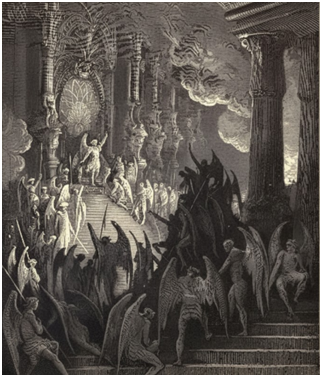
..To do aught good never will be our task,
But ever to do ill our sole delight,
As being the contrary to his high will
Whom we resist. If then his Providence
Out of our evil seek to bring forth good,
Our labour must be to pervert that end,
And out of good still to find means of evil...”
John Milton may have been onto something… And for those wondering, no, I didn’t read “Paradise Lost” until after I’d completed my trip in the elevator.
The second subject I want to talk about is Sin and the precise moment in time when I bent my will to the task of “taking the elevator all the way down.” Generally, when Christians talk about Sin, we frame it as “this action” or “that action” being wrong. The Catholic Church (and probably most Christian sects) identifies it as “an offense against God, defined as an act, word, or desire that goes against God’s will, reason, and conscience.”
Sin is also associated with an archery term, meaning to “miss the mark.” In a way, that short summary felt most suitable for what I was experiencing—everything seemed to be missing the mark.
I knew there was a deeper malaise at work than the laundry list of sins that I might bother to confess. On a particular day in 2019, I wrote a note to myself about what seemed to be happening to me. Here is the entry:
“…Just by waking up and going to work today, I am sinning. This laptop is a sin. The house and chair I sit in is a sin. The car I drive is a sin. The money I make is a sin. The greater story about life—get a job, get a career, acquire “things”, have a family, do your duty to society—that is the sin. But we don’t want to go that far. We want to go just far enough to make ourselves feel good—or if not good, at least content in the belief that we’ve given up something difficult or made some small sacrifice or even confessed some small specifically identified ‘sin’.”
Like the radiation emanating from the Elephant’s Foot in the basement of Chernobyl, this sickness was all around me, greater than any one item I could address in my life. Instead of doubling down on more religious practices that for a long time seemed to have been bereft of power, I fully committed myself to the elevator, and as the saying goes, I would try to “find the bottom.”
Next, I want to talk about categories of Sin, and since we are already talking about Catholic doctrine, we’ll just stick with that. For the Catholics, Sin is grouped into two categories: Mortal and Venial. Generally, the idea behind Mortal sin is that it “kills the life of grace in the soul” and “destroys charity in the heart of man by a grave violation of God’s law; it turns man away from God, who is his ultimate end and his beatitude, by preferring an inferior good to him. Venial sin allows charity to subsist, even though it offends and wounds it.”
Just as there are three ingredients in evaluating a moral action (the object, intention, and circumstances), so there are three ingredients in a mortal sin: (1) “grave matter,” (2) “full knowledge,” and (3) “deliberate consent.” And the Catechism is clear that all “three conditions must together be met” to constitute a mortal sin (1857).
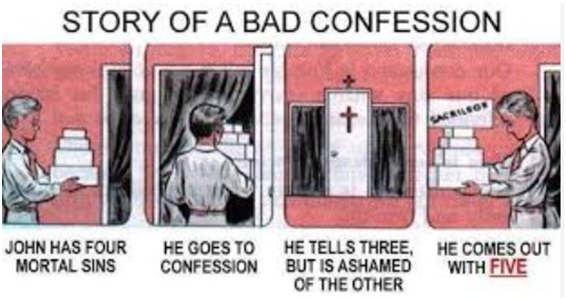
A picture story from the Baltimore Catechism—Where John appears to accumulate mortal sins as a pass time
Based on this formal definition and the picture above, you might imagine mortal sins are fairly easy to commit and that the soul is like a fragile butterfly, where if you make one wrong move you are going to crush it or accidentally pile on more than it can bear. I’m not here to argue the point, maybe that is the case.
I would even say the first and third conditions on that list—grave matter and deliberate consent—are perhaps the easiest to fulfill. Full knowledge, however, seems to be the more elusive criteria to meet. I know we like to think we are smart, and that we have a grasp on the “actions” and what they entail, but I’m not sure that we do.
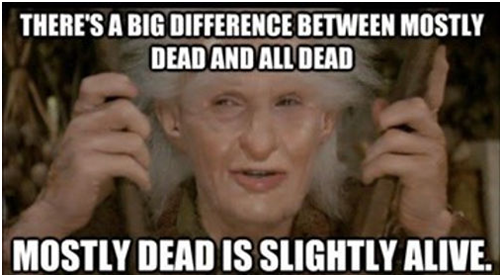
Maybe that lack of understanding is to our benefit—the unflinching resolve, terrifying lucidity, and final act of the will to commit spiritual suicide seems a herculean effort to execute in hindsight. Even after years of repeatedly wading into and under the cesspool of human atrocities in a vain attempt to find the bottom (and ignoring what all adhering Catholics would say are “The rules”), I still seemed to exist in some state that could best be summarized by this picture from the movie The Princess Bride:
After St. Joan of Arc was captured by the English and she was put on trial, her interrogators asked her if she was in a state of grace in a ploy to trap her. Her response was, “If I am not, may God put me there; and if I am, may God so keep me”.
My mantra during this time was probably some sort of inversion of that as I sought to understand the unintelligible, unforgiveable, and obscene.
Finally, after enough iterations of doing this, a strange sort of cold clarity took hold.
The physics that took our lives, the diseases that ravaged us, all the myriads of “natural evils” that seemed so unnecessary—maybe they were just the escape hatch off this botched planet of the apes.
While the moral evils—the wrath that delighted in violence, the envy that desired what others possessed, the lust that led to unfettered perversions, the greed that must always have more, the sloth that made the apathy and indifference so easy, the gluttony that could consume without being satiated, and finally the pride… the pride that insisted on its own righteousness and looked askance at all the faults in existence and thought I could have done better—they were all now perfectly understandable. And not only understandable—the repulsive actions and monstrosities that had horrified me when I first began were also accessible.
At the same time, when I finally paused to contemplate the madness that threatened to consume me, I saw in some inexplicable way I had become worse than any of the deviants and tyrants I had studied—my bitterness, my ingratitude, my thirst for revenge and my disgust with existence had all coalesced into a hatred for the Creator itself. I had burrowed and worried and wrote and re-wrote my book and drowned and re-drowned the unseen, ethereal parts of me until it seemed that I had worn reality thin and whatever lay on the other side could finally whisper into my thoughts.
Existence itself misses the mark. The thing said. There are people and events long since passed that led you to this station in life: participating in wars that waste resources, sitting in meetings that solve nothing, your fate guided by unreachable ‘officials’ that pull the levers of power so the masses can glut themselves on entertainment and material goods. And you hate all of them, and the systems they’ve constructed, and you hate all the moments that led to this moment and you hate whatever hand first spun the Universe out of nothing. You would do unto them what they have done to you, given the opportunity.
There was no denying it—the voice spoke the truth.
I was wrong when we talked, I hadn’t read this one yet. Good stuff, keep it going!